


Controlling Fumes in your Garage
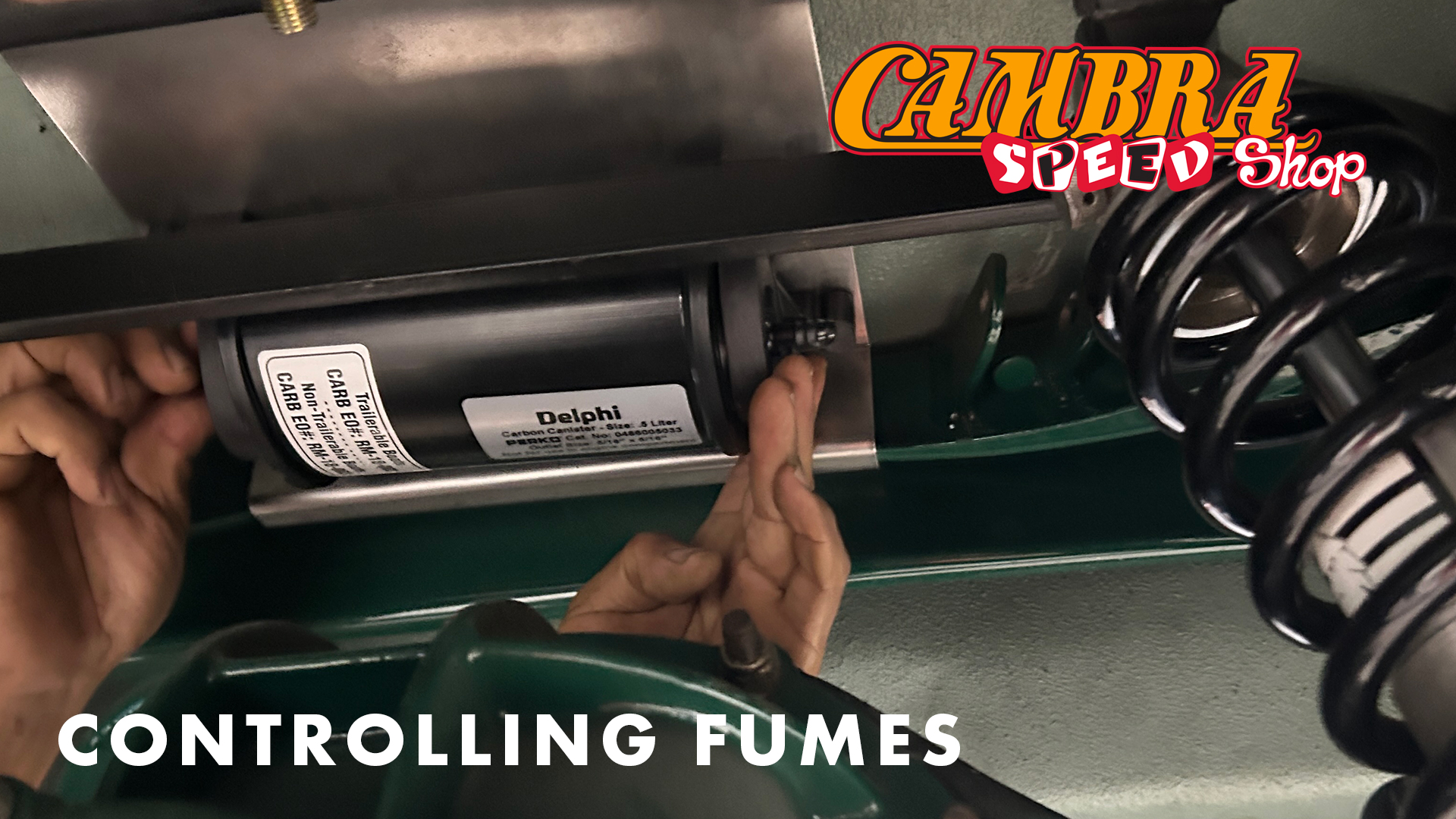
I don’t know about you, I prefer the smell of burnt gasoline along with roasted tires rather than the fumes of fresh gas in my garage. We recently helped two of our customers with this problem. One was a 50 Oldsmobile street rod the other a fully custom ’68 Chevy C10. The Olds Dave built a mounting plate and bracket for a Delphi Charcoal Canister and mounted it under the trunk. The truck received an aftermarket version called Vapor Trapper which we mounted under the front bed frame rail. The idea is to plumb a line from the vent to a carbon canister and then plumb it out with an open end pointing to the ground. This is the same technology used in American Cars from 1971 forward. (1970 in California).
1950 Oldsmobile

Dave made this simple mounting plate and bracket hidden under the trunk floor.

The finished product complete with trim black and button head stainless hardware.
1968 Chevy C10

For this build we used an aftermarket performance charcoal filter.

Here’s the final installation. We used stainless steel lines for this build.
Why Vapor Control Makes Sense for Your Collector Car
There are certain smells that belong with an old car. Leather. Oil. Hot exhaust. Maybe a hint of carburetor after a cold start. But walking into your garage and getting hit with raw gasoline fumes? That’s one piece of nostalgia we can probably leave behind. And that brings up an often-overlooked part of building a classic car for the way we actually use them today.
Old Cars Were Built for a Different World
Older fuel systems are relatively simple. That simplicity is part of their charm, but it also means many classic cars allow fuel-tank vapors to vent directly to the atmosphere. Gasoline is constantly producing vapor inside the tank. Changes in temperature can increase that vapor production and pressure. Modern vehicles manage those vapors using evaporative-emissions systems, commonly capturing them in activated-charcoal canisters rather than simply releasing them.
A collector car presents another challenge:
It may sit for days or weeks at a time.
That beautiful coupe, roadster or custom might spend considerably more time parked in an enclosed garage than cruising down the highway. Over time, even a small amount of fuel vapor escaping from the vehicle becomes noticeable. Especially when that garage is attached to the house.
More Than Just a Bad Smell
That familiar gasoline odor isn’t simply inconvenient. Gasoline vapors contain volatile hydrocarbons, and uncontrolled vapors can migrate beyond the immediate area where the vehicle is stored. Research involving vehicles parked in attached garages has demonstrated that evaporative fuel emissions can affect air inside the garage and adjoining living spaces.
Then there is the obvious issue: gasoline vapor is flammable.
You wouldn’t intentionally leave a container of gasoline evaporating in your garage. Yet an improperly vented classic-car fuel system can essentially provide a much smaller version of the same problem. Vapor control provides a better way.
So, What Does Vapor Control Do?
The basic concept is surprisingly straightforward.
Instead of allowing fuel vapors to vent freely from the tank, the system routes those vapors through components designed to contain and manage them. Activated charcoal has been used by automobile manufacturers for decades because it can adsorb and temporarily store gasoline vapors. In a traditional evaporative-control system, those captured vapors can later be routed into the engine and burned during operation.
Installing vapor control on a custom or collector vehicle isn’t necessarily about duplicating every component found on a late-model car.
It’s about properly managing the fuel tank’s need to breathe without letting the garage become the vent.
The exact solution depends on the fuel tank, filler arrangement, engine, induction system and how the vehicle is built. Like so many things on a custom car, the details matter.
Modern Convenience Without Modernizing the Car
This is where vapor control fits perfectly with the way we approach cars at Cambra Speed Shop. Not every improvement needs to be visible. You can retain the stance, the wheels, the engine, the upholstery and the personality that made you fall in love with the car while quietly improving what it’s like to actually own.
Better cooling systems did it. Better brakes did it. Electronic ignition did it. Improved fuel delivery did it. And for a car that spends part of its life sitting inside a garage, vapor control can do it too. You just don’t smell gasoline every time you walk into the garage.
The Details Make a Great Car Better
Some of the best modifications aren’t the ones people notice at a car show. They’re the ones the owner notices every time they use the car. A door that closes correctly. An engine that starts when it’s hot. Air conditioning that works in traffic. Brakes that inspire confidence. A fuel system that doesn’t stink up the house.
Those things may not win a trophy, but they can dramatically change how much you enjoy owning and driving a collector car. That’s what makes vapor control such a smart upgrade.
It’s not about changing an old car into a new one. It’s about fixing one of the old-car problems we no longer have to live with.
If your classic, hot rod or custom leaves the garage smelling like gasoline every time it sits, Cambra Speed Shop can help. Talk with us about adding a properly designed vapor control system to your car—one that works with the vehicle, stays out of sight and makes owning it that much more enjoyable.
Keep the character. Lose the fumes. Contact Cambra Speed Shop and let’s get your vapor problem under control.